

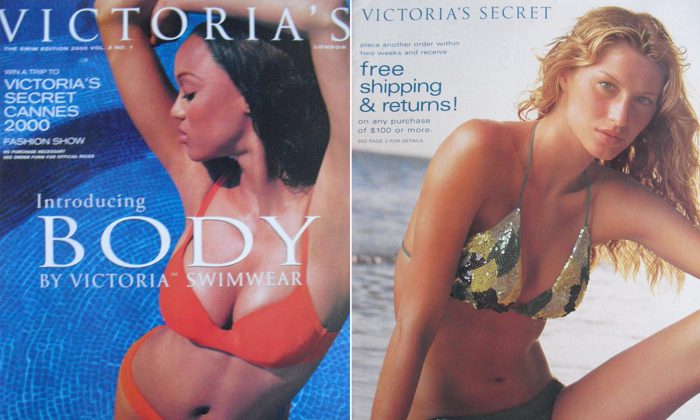
¶The catalog ended. The mail didn't.
Victoria’s Secret stopped printing its catalog in 2016. Yet they continue to send promotional post cards and other marketing mail.
That gap explains most of the confusion around Victoria’s Secret mailing list and how to remove yourself from it. People remember the catalog, so they assume the mail arriving now means their opt-out failed, or that the catalog secretly continued. Neither is true, and the real story runs through one of the more remarkable rise-and-fall arcs in American retail.
PaperKarma has been filing opt-out requests with Victoria’s Secret on subscribers’ behalf for well over a decade, so we can describe what their opt-out process actually does from primary-source correspondence. Start with why so many people wanted one in the first place.
¶Why this catalog, of all catalogs, drove opt-outs
Most catalogs annoy people. The Victoria’s Secret catalog embarrassed them.
It was, by design, the most provocative piece of mail in mainstream circulation: hundreds of millions of copies a year of lingerie photography, delivered unsolicited to shared mailboxes, family kitchen tables, and office mailrooms. Plenty of recipients enjoyed it. A steady share did not want it arriving where their kids sorted the mail, and that discomfort made it a perennial target of removal requests.
Recipients bothered on those grounds have long held an unusual legal tool. Since Rowan v. U.S. Post Office Department (1970) and the Pandering Advertisements Statute, any addressee can file USPS Form 1500 against advertising they consider sexually provocative, and the recipient’s judgment is final. Provocative catalogs are the textbook case.
We tell the full story of that law in 7 Times Obscene Mail Scandalized America.
¶The rise, the fall, and what it did to your mailbox
The Victoria’s Secret catalog was one of the biggest direct-mail programs in America: hundreds of millions of copies a year, at a reported annual cost in the $125 to 150 million range. In 2016, Les Wexner’s L Brands killed it, along with the swimwear line, to refocus the business on core lingerie. The business press wrote the obituaries that spring.
The catalog’s end turned out to be the opening chapter of a larger unraveling. The brand had been built on a single aesthetic, the “Angel” fantasy (manifested in rail-thin, extremely-tall super models), and taste moved against it. Sales faltered from the mid-2010s as shoppers shifted to bralettes and sports bras, and US market share slid from 33 percent to 24 percent between 2016 and 2018.
Body-positive rivals took the ground the Angels gave up. Aerie, ThirdLove, and Lively grew on inclusive sizing and unretouched marketing, and Rihanna’s Savage X Fenty arrived in 2018 with runway shows that celebrated every body the old brand excluded.
The controversy then came to a head. Chief marketing officer Ed Razek’s dismissive 2018 comments about plus-size and transgender models drew industry-wide fallout and preceded his 2019 resignation; the televised fashion show was canceled that November.
As mall traffic declined, the company closed up to 250 stores in 2020, and L Brands spun Victoria’s Secret & Co. off as a standalone company in August 2021. The comeback era since (the show returned in 2024) is its own story.
Two things in that arc matter for your mailbox. First, the catalog is genuinely gone, but the mailing list survived the brand’s every phase: promotional postcards, coupon mailers, and seasonal offers still go out to it, with a maintained removal process at customer care. Your opt-out request now goes to Victoria’s Secret & Co., a separate company from Bath & Body Works with a separate list.
Second, the inclusive brands that won the decade are mailers too. Plus-size and comfort-first labels, from heritage names like Lane Bryant to the newer entrants, court customers with their own catalogs and promotional mail.
Whoever wins the lingerie wars, the mailbox loses, and any addressed catalog opts out the same way. Our guide to stopping catalogs covers the whole category.
¶What a Victoria's Secret opt-out actually does
Victoria’s Secret honors written opt-out requests, including requests filed by a third party such as PaperKarma on a customer’s behalf, and replies with specifics: what was removed and how long the change takes. One line from their customer-service correspondence explains more “failed” opt-outs than anything else written on the subject:
It may take up to 90 days for you to stop receiving our catalogues as they are preprinted. We appreciate your patience as this change is being implemented.Victoria's Secret customer service, reply to a PaperKarma opt-out request
Two details in that correspondence do real work. The email list and the postal list are handled separately, on separate timelines (days for email, up to 90 days for print). And the delay is mechanical rather than evasive: promotional mail is printed and staged far in advance, so removal from the list cannot recall pieces already in the pipeline.
Those two details are the anatomy of almost every “my opt-out failed” story, for any mailer.
“I opted out and mail kept coming, so the opt-out failed.”
Mail arriving inside the processing window is pipeline, not failure: pieces are preprinted, Victoria's Secret's own correspondence has quoted up to 90 days for print, and independent reporting puts typical list processing at four to six weeks. Mail arriving after the window usually means a different list. An opt-out suppresses your record in the sender's own house file; a piece sourced from a rented or cooperative list was never covered by it, and the label often shows the difference: a customer number that is all zeros means the sender has no account for you at all. Our catalog guide covers how to read that signal.
“I unsubscribed from their emails, so the paper mail should stop.”
Email and postal suppression are separate systems with separate timelines, and always have been; Victoria's Secret's own replies described removing an email address within days while quoting up to 90 days for print. Clicking unsubscribe at the bottom of a promotional email does nothing to the postal file. If the paper mail is the problem, the request has to name the postal mailing list specifically.
¶What each opt-out actually removes
Put the pieces together and the confusion dissolves into a short map.
A postal opt-out with Victoria’s Secret removes your record from their house mailing file. Their own future mailings stop once the preprinted pipeline drains.
An email unsubscribe removes your address from their email program. It touches nothing on paper.
A Form 1500 prohibitory order is the special case: a federal order against a specific mailer whose advertising you deem provocative, with the deeper history covered in our obscene-mail history.
None of these touch the shared layer: the rented and cooperative databases (Epsilon’s Abacus co-op is the best-known) through which retailers source prospect addresses. Records there are suppressed through the co-ops’ own processes, separately from any single brand.
That layered structure is not a Victoria’s Secret quirk; it is how retail direct mail works everywhere, for the inclusive newcomers as much as the Angels. PaperKarma’s role is to be the catch-all for that labor: photograph any mailer and we file the right request with the right party, and keep filing as new senders surface.
¶If you just want the mail to stop
To remove yourself from Victoria’s Secret, find the most current procedure at our Victoria’s Secret opt-out page. Quoting the customer number printed near your address makes any removal request faster and more reliable.
For the whole mailbox, PaperKarma is the one-photo version: snap the mailer, we handle the sender.
¶Frequently asked questions
Why do I still get Victoria's Secret mail after unsubscribing?
Three ordinary reasons, none of them a broken opt-out. Promotional mail is printed and staged weeks ahead, so pieces already in the pipeline arrive after your request is processed; Victoria’s Secret’s own customer-service correspondence has put the tail at up to 90 days. Email and postal preferences are separate systems, so an email unsubscribe does not touch the postal file.
Does Victoria's Secret still send catalogs?
No. The famous big-book catalog was discontinued in 2016. What continues is promotional mail: postcards, coupon mailers, and seasonal offers sent to the company’s mailing list. People often call any of it “the catalog,” which is how the impression persists that the catalog never really ended.
Does unsubscribing from Victoria's Secret emails stop the paper mail?
No. Email and postal mailing lists are maintained separately, with separate suppression processes and different timelines. Victoria’s Secret’s own service replies have described email removal taking days and catalog-era postal removal taking up to 90 days. If the paper mail is what bothers you, you need a postal opt-out specifically: through their customer service, or by photographing the mailer with PaperKarma.
Did Victoria's Secret sell my address?
Not necessarily, and the arrival of mail is not proof of it. Retail mailing programs source addresses from their own customer files and from rented or cooperative lists that many mailers share. If you shopped there, you are likely in the house file. If you never did, your address most plausibly came through a shared or rented list. Either way the fix is the same: an opt-out request against the sender, plus getting off the lists that keep re-supplying your address.
Can I stop mail I find too provocative for my mailbox?
Yes, and the recipient’s judgment controls. Under the Pandering Advertisements Statute (39 U.S.C. 3008), any addressee can file USPS Form 1500 to obtain a prohibitory order against a mailer whose advertising they consider sexually provocative, a standard the Supreme Court left entirely to the recipient in Rowan v. U.S. Post Office Department (1970). Provocative lingerie catalogs were a classic use case. For ordinary promotional mail, a standard opt-out (or a PaperKarma photo) is the simpler route.
How long does a Victoria's Secret opt-out take?
Plan on weeks, not days. Victoria’s Secret’s customer-service correspondence has historically quoted up to 90 days for postal mail because pieces are preprinted, and independent reporting puts typical list processing at four to six weeks. Across all senders, 8 to 12 weeks is the realistic window for mail volume to visibly drop. Mail that arrives inside that window is pipeline, not failure.
Sources
- BuzzFeed News, Farewell, Victoria’s Secret Catalog (2016 discontinuation, catalog spend)
- Racked, The History of the Victoria’s Secret Catalog
- Associated Press, The rise and fall of Victoria’s Secret (market share, Razek comments and resignation, show cancellation, store closures, competitors, comeback)
- Fashionista, Ed Razek’s Controversial Comments Continue to Attract Fallout (2018)
- Victoria’s Secret & Co., Completion of Separation from Bath & Body Works (August 2021)
- Victoria’s Secret Customer Care, mailing list changes and removal
- DeleteMe, How to Get Off Victoria’s Secret’s Mailing List (processing time, post-opt-out mail)
- StopCatalogs.com, How to Opt Out of Epsilon and the Abacus Co-op (cooperative databases)
- Rowan v. United States Post Office Department, 397 U.S. 728 (1970)
- PaperKarma opt-out correspondence with Victoria’s Secret customer service (quoted excerpt; subscriber and representative names withheld).