

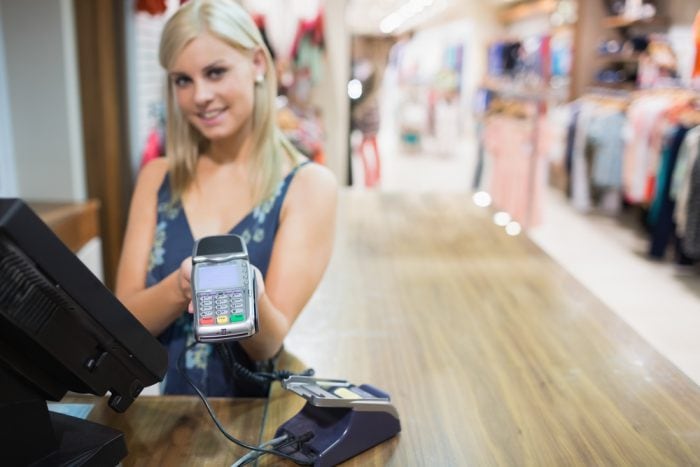
¶Five digits, one household
A five-digit ZIP code narrows the United States to a few thousand households. The name printed on your credit card narrows those thousands, in most cases, to one.
That is the whole reason the question exists. "Can I get your ZIP code?" sounds like small talk at the register. It is the cheapest piece of a customer record a retailer can collect, because you will say five digits out loud without thinking, and because the rest of the record can be bought.
Ask a clerk why the store wants it and the honest answer, when you get one, is "marketing purposes." This page is about what that phrase actually contains.
¶The mechanism: reverse append
When you pay by card, the retailer sees the name on the card. Your ZIP code is the missing ingredient that turns that name into a mailable identity.
Data services sell the match directly. The retailer submits name plus ZIP; the service checks the pair against its consumer database and returns your full mailing address, and often more. The industry term is reverse append.
This is not a fringe practice. Harte-Hanks marketed its version as GeoCapture and claimed match rates approaching 100 percent. FICO sold a competing product, Contact Builder, and pitched it as boosting direct-marketing reach as much as 400 percent.
The New York Times covered the checkout version of the practice back in 2013. It is the reason your mailbox can fill with catalogs from a store you visited exactly once, paid by card, and never gave your address.
Once the match is made, the record does not necessarily stay with the store. Customer files are marketing assets. They get rented to other mailers, traded into cooperative databases, and sold to data brokers, the industry the FTC described in its 2014 report as operating with "a fundamental lack of transparency." One volunteered ZIP code can echo for years.
An estimated 87 percent of Americans can be uniquely identified from just three data points: ZIP code, date of birth, and sex. The finding, from Latanya Sweeney's work at Carnegie Mellon, is the classic demonstration that "anonymous" demographic fragments mostly are not.
¶Why two state supreme courts stepped in
The practice was contested in court, and the two landmark rulings are worth knowing because they describe exactly what retailers were doing with the digits.
In Pineda v. Williams-Sonoma (2011), the California Supreme Court held that a ZIP code is "personal identification information" under the state’s Song-Beverly Credit Card Act, which bars merchants from requesting and recording such information as a condition of a credit card transaction. The complaint described the mechanics plainly: the retailer used the customer’s name and ZIP to locate her home address through a database, kept the record, and used it for marketing.
Violations carry civil penalties of up to $250 for a first offense and $1,000 for each offense after that.
Massachusetts followed in Tyler v. Michaels Stores (2013). The state’s Supreme Judicial Court ruled that ZIP codes are personal identification information under Massachusetts consumer law, and, notably for our purposes, that receiving unwanted marketing mail is itself a legally cognizable injury.
Sit with that for a second: a state high court looked at junk mail and called it a harm worth suing over.
Everywhere else, the ask remains broadly legal. There is no federal rule against it, and most states have nothing comparable on the books. With no statute doing the work in most places, the practical protection is your own decline.
¶When the ZIP request is legitimate
“The store needs my ZIP code to complete the sale.”
At a staffed register, no. The card transaction approves without it, and clerks will complete the sale if you decline. The real exceptions: pay-at-the-pump and other unattended card readers use your billing ZIP as a fraud check with the card networks before approving, and online checkouts need address fields for shipping and sales tax. The test is simple: if the transaction physically cannot proceed without the ZIP, it is verification. If a human is asking while the card is already approving, it is marketing.
Retailers also use ZIP data in a genuinely boring way: aggregated, it shows where customers drive from, which informs where to open the next store. Collected that way, in the aggregate, it identifies nobody.
Aggregate ZIP data also feeds saturation advertising. If a ZIP performs well, a retailer may blanket its carrier routes with unaddressed mail through USPS’s Every Door Direct Mail program.
Two things are worth knowing there. EDDM pieces go to every address on selected carrier routes, addressed to "Postal Customer" rather than to you, so your individual ZIP disclosure is not what puts them in your box. And because there is no name and no list behind them, they cannot be individually opted out of; USPS designed the product without that mechanism.
The mail you can do something about is the addressed kind, and that is the kind reverse append produces.
¶From five digits to a mailing list
Here is the full pipeline, compressed. You pay by card and volunteer your ZIP. The retailer appends your address and adds you to its house file. The house file gets rented or contributed to co-op databases shared across mailers. Brokers segment those records by ZIP-level demographics and sell access to whoever is mailing next season.
Each step is legal nearly everywhere, invisible to you, and quietly cumulative. You gave out five digits once; three catalogs, two charity appeals, and an insurance pitch show up eighteen months later from senders you have never heard of.
That downstream tangle is why "just contact the store" undersells the problem. The store that collected your ZIP is one node. The list your address now sits on has many.
¶What you can actually do
At the register, decline. "No thanks" ends the collection at its cheapest point, and the sale goes through. If a form asks for a ZIP where none is plausibly needed (warranty cards are a classic), leave it blank.
For the addressed mail already arriving, the fix is removal from the lists, sender by sender. The do-it-yourself route works: use the phone number or web form on each piece, give your exact name and address, and ask to be removed and not shared. It is reliable, and it is one sender at a time, repeated as the lists rebuild.
PaperKarma is the catch-all version of the same request. Snap a photo of the mailer; we identify the sender, file the opt-out with your details, and keep going as new senders surface. One subscription covers catalogs, credit offers, charity appeals, and the rest of the addressed-mail spectrum. Our guide to stopping junk mail walks through every route if you want the full map.
Either way, expect the volume to taper over 8 to 12 weeks rather than overnight, because mail in the pipeline was printed weeks ago and different lists cycle at different speeds.
The ZIP code question is not going away; the match it enables is too cheap and too useful to marketers. But it only works with your five digits in it. They are yours to withhold, and the mail that already resulted is yours to shut off.
¶Frequently asked questions
Is it safe to give a store my ZIP code?
It is not dangerous the way handing over a card number would be, but it is not neutral either. When a cashier keys your ZIP alongside a card transaction, the retailer can match it with the name on your card against commercial databases to identify your full mailing address, then market to you or share the record. If you would rather not be added to mailing lists, decline. At a physical register the sale goes through without it.
Why do gas stations require a ZIP code at the pump?
That one is fraud prevention, not marketing. Unattended card readers ask for the billing ZIP on the card account and check it with the card networks before approving the purchase, because stolen cards are disproportionately tested at unattended pumps. The pump needs the ZIP where the register does not, and entering it there does not put you on a mailing list.
Can a store really find my address from my ZIP code?
Usually, yes, if it also has your name. Data services sell this exact match: the retailer submits the name from your credit card plus your ZIP code, and the service returns your full address from its database. Harte-Hanks marketed the service as GeoCapture and claimed match rates approaching 100 percent. Five digits feel anonymous; paired with a name, they mostly are not.
Is it illegal for stores to ask for my ZIP code?
In most states, asking is legal. The exceptions come from state consumer-protection law on credit card transactions. California’s Supreme Court ruled in 2011 (Pineda v. Williams-Sonoma) that a ZIP code is personal identification information that merchants may not request and record during a credit card sale, and Massachusetts’ high court reached a similar conclusion in 2013 (Tyler v. Michaels Stores). Elsewhere the practice is generally permitted, which is why the practical protection is declining.
How do I stop the junk mail that comes from giving out my ZIP code?
Once your address is on marketing lists, the fix is getting your name off them, sender by sender. You can contact each mailer yourself using the contact information printed on the piece, or let PaperKarma do it: photograph the mailer and we file the opt-out request with the sender for you, across every category of addressed advertising mail. Expect volume to taper over 8 to 12 weeks as the lists cycle.
- The New York Times, Why Retailers Ask for Your ZIP Code (2013)
- Forbes, Never Give Stores Your ZIP Code. Here’s Why (reverse append; Harte-Hanks GeoCapture; FICO Contact Builder)
- Forbes, Yes, Gas Pumps Really Do Need Your ZIP Code (AVS fraud checks at unattended terminals)
- Pineda v. Williams-Sonoma Stores, Inc., 51 Cal. 4th 524 (2011)
- Tyler v. Michaels Stores, Inc., 464 Mass. 492 (2013)
- FTC, Data Brokers: A Call for Transparency and Accountability (2014)
- Latanya Sweeney, Simple Demographics Often Identify People Uniquely (Carnegie Mellon, 2000)