

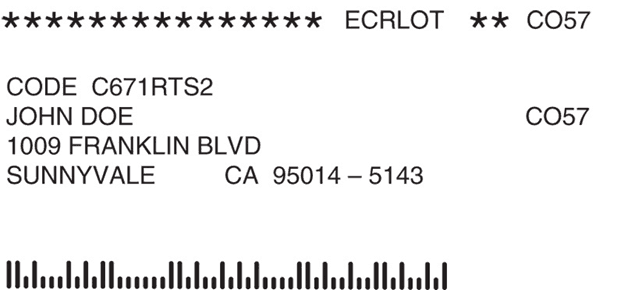
¶You're holding a label covered in codes. Here's how to read all of it.
Most people land here for one of two reasons. Either a flyer or postcard arrived with a row of asterisks and the word ECRLOT above your name, or you flipped over a magazine and found a clump of letters and numbers next to your address that look like a tracking code.
They are not tracking codes, and almost none of them are about you. Some are the mailer’s postage paperwork, printed where you happen to see it. A couple, on a magazine, are genuinely useful for managing your subscription. And one piece of information on the label, hiding in plain sight, tells you whether the mail in your hand can be stopped or whether you are stuck with it. We will decode all of it, starting with the code that brought most people here.
¶What ECRLOT actually means
ECRLOT stands for Enhanced Carrier Route, Line of Travel.
Break it into parts. " Enhanced Carrier Route" (ECR) is a family of discounted bulk-mail prices inside the class USPS now calls Marketing Mail. It was renamed from Standard Mail in 2017, though most people still call it junk mail. " Line of Travel" means the mailer arranged the pieces in the order your letter carrier physically walks or drives the route, so the carrier can deliver them without re-sorting. The less work the Postal Service has to do, the cheaper the postage. ECRLOT is the marking that proves the mailer did that sorting and earned the discount.
The full line is called an Optional Endorsement Line (OEL). The long run of asterisks is just padding that pushes the meaningful text to a consistent spot for postal equipment to read. The bit after the asterisks, such as C-001, is the carrier route: " C" for a regular carrier route, then the route’s three-digit number. None of it identifies you. It is the mailer telling USPS how the batch was prepared.
One correction worth making, since older explanations of this code get it wrong: ECRLOT has nothing to do with mailing something a certain number of days in advance. It is a sortation discount, earned by arranging pieces in carrier-route order, not a discount for timing.
¶ECRLOT vs. ECRWSH vs. ECRWSS: the tiers and what they signal
ECRLOT is the lightest tier of the carrier-route discount. There are deeper ones, and you will see their codes on other pieces. The difference is how many homes on a route the mailer is covering. The more saturated the coverage, the bigger the discount.
| Code | Tier | What it requires | What it tells you | Badge |
|---|---|---|---|---|
| ECRLOTRecommended | Basic (Line of Travel) | At least 10 pieces to the same carrier route | A targeted list mailing, sorted in route order. Addressed to you by name. | Stop w/ PaperKarma |
| ECRWSH | High Density (and High Density Plus) | 125+ pieces per route (300+ for the Plus tier) | The mailer is blanketing most of the block. Usually still addressed by name. | |
| ECRWSS | Saturation | About 90% of homes on the route | Maximum coverage, deepest discount. This is the endorsement on Every Door Direct Mail (EDDM). |
- Tier
- Basic (Line of Travel)
- What it requires
- At least 10 pieces to the same carrier route
- What it tells you
- A targeted list mailing, sorted in route order. Addressed to you by name.
- Badge
- Stop w/ PaperKarma
- Tier
- High Density (and High Density Plus)
- What it requires
- 125+ pieces per route (300+ for the Plus tier)
- What it tells you
- The mailer is blanketing most of the block. Usually still addressed by name.
- Badge
- Tier
- Saturation
- What it requires
- About 90% of homes on the route
- What it tells you
- Maximum coverage, deepest discount. This is the endorsement on Every Door Direct Mail (EDDM).
- Badge
For scale, saturation letters run about 24.4 cents a piece in 2026, and EDDM is in the same range at roughly 24 to 25 cents. That is a fraction of a First-Class stamp. The cheapness is the whole point: it is how a local business affords to hit tens of thousands of mailboxes at once.
¶What's on a magazine mailing label
A magazine label looks busier than a junk-mail label because it carries information meant for you, not just for the Post Office. Flip the magazine so the label reads right-side up and you will usually find four things:
- Your name and address, in normal address form.
- A subscriber or account number, often just above your name. This is your ID on the publisher’s list. Keep it; you will want it for renewals, address changes, or customer-service calls.
- An expiration code, frequently above the name on the right, written as a month and year like
DEC26orOct 2026. That is when your paid subscription runs out, printed there so you know when to renew. - A sortation endorsement, the same asterisk-and-code line we have been decoding.
Here is the part that trips people up. The endorsement on a magazine depends on how it was mailed. A paid subscription magazine on a Periodicals permit typically shows CAR-RT LOT (or a similar CR-RT marking), the Periodicals version of the carrier-route discount. A catalog or a free, ad-supported magazine mailed at Marketing Mail rates shows ECRLOT instead. Same idea, different mail class.
That distinction matters more than it looks. A magazine you subscribed to is mail you asked for, and the codes on it are tools for managing a subscription you chose. A catalog or ad-magazine you never ordered, the kind that shows up bearing ECRLOT, is unsolicited mail you can do something about. Which brings us to the useful part.
¶What changed in 2025 (and why you may see more blanket mail)
The answer we gave to this question years ago is now partly out of date, because USPS restructured Marketing Mail pricing on July 13, 2025.
The change that matters most here: USPS eliminated the automation Basic Carrier Route letter rate, the exact rate an ECRLOT letter used to claim. In the same round it removed the Network Distribution Center (NDC) entry discount, cut the Sectional Center Facility (SCF) discount by about 30 percent, and raised Marketing Mail prices roughly 7.4 percent on average.
We will not claim this single change " caused" any particular shift in your mailbox; mail volume moves for many reasons. But the direction of the incentive is clear enough to name. When the cheapest addressed-letter tier disappears and entry discounts shrink, the math tilts further toward the deepest options, saturation and EDDM, the blanket mail sent to " every door" rather than to a list. Those are exactly the pieces you have the least control over, for the reason we get to next.
¶The useful part: the label tells you whether you can stop it
Here is the part worth keeping. How a piece is addressed, taken with the endorsement code, tells you whether the mail can be stopped.
If a piece is addressed to you by name (ECRLOT mail always is, and most high-density and saturation list mail is too), then a mailer bought or built a list with your name on it. That is oddly good news. Being on a list means there is a list to be removed from. Opt-outs work on this mail.
If a piece is addressed to " Postal Customer," " Resident," or " Current Occupant" and carries the ECRWSS endorsement, it is almost certainly Every Door Direct Mail. The advertiser never bought your name. They paid to hit every address on a route, sight unseen. There is no list, so there is nothing to opt out of.
Opt-out requests and suppression services do not apply to EDDM. Because the mail is addressed to "Postal Customer" rather than to you, USPS treats it as unaddressed mail and will not honor a refusal.Industry guidance on EDDM, consistent across mail-service providers
So the practical reading of your label is:
- Your name + ECRLOT (or ECRWSH): you are on a list. This is the half of your junk mail you can actually do something about.
- "Postal Customer"/"Resident" + ECRWSS: EDDM. No list, no opt-out, no refusal. The only real fixes here are policy-level, and the US does not currently have a national Do Not Mail registry.
For the addressed half, the fastest route is PaperKarma. Take a photo of the piece and we contact the mailer and get you removed. One subscription covers every sender, which is the point: ECRLOT mail can come from any business that built or rented a list, and no opt-out registry covers all of them. The do-it-yourself alternative is to chase each sender’s own opt-out line one at a time. Many print it right on the piece; the James Avery flyer, for one, says " Visit JamesAvery. com/remove." That works if you have the patience, but you are doing it sender by sender, and the lists rebuild.
¶The numbers that do identify you, and which to keep
Most of the label is noise, but a few numbers are worth knowing.
Ignore: the asterisks, the carrier route (C-001), and the postal permit numbers. These are USPS and mailer sortation and billing markings. They do nothing for you.
Keep: any number that identifies you on a sender’s list. On a magazine that is the subscriber or account number. On a catalog or ad mailer it is often labeled " Customer Number," " Key Code," or " Source Code," sometimes boxed in color near your name. When you ask to be removed from a list, handing the sender that code points them straight to your record, which can make the opt-out faster and more reliable. PaperKarma asks for one of these only when a specific mailer needs it to process the removal.
For a fuller field guide to every marking that turns up on a bulk-mail label, see our companion piece on junk mail address label codes, or, if you are opting out of catalogs specifically, how to use customer numbers when opting out.
¶Frequently asked questions
What does ECRLOT mean?
ECRLOT stands for Enhanced Carrier Route, Line of Travel. It is a postage-discount marking a bulk mailer earned by sorting their batch into your letter carrier’s route order. It is not a flag on you and not the result of anything you did.
What does ECRWSS mean?
ECRWSS stands for Enhanced Carrier Route Walk Sequence Saturation. It marks mail sent to roughly every address on a carrier route, and it is the endorsement used for Every Door Direct Mail (EDDM). When ECRWSS appears with a " Postal Customer" or " Resident" address rather than your name, there is no list behind it, so it cannot be individually opted out.
What does ECRWSH mean?
ECRWSH stands for Enhanced Carrier Route Walk Sequence High Density. It sits between basic ECRLOT and full saturation: the mailer is hitting at least 125 pieces per route (300 or more for the High Density Plus tier). High-density pieces are usually still addressed to you by name, which means they can typically be stopped.
How do I read my magazine's mailing label?
Flip the magazine so the label is right-side up. You will see your name and address, a subscriber or account number (usually above your name), a subscription expiration date written as a month and year like DEC26, and a postal sortation code. The account number and expiration date are the useful parts for managing your subscription.
Where is the expiration date on a magazine label, and what does it mean?
It is usually printed above your name, often on the right, as a month and year (for example, Oct 2026). It tells you the issue at which your paid subscription ends, so you know when a renewal is actually due rather than relying on the early renewal notices publishers tend to send.
Can I stop ECRLOT mail?
Yes. ECRLOT mail is addressed to you by name, which means a list exists with you on it. The fastest fix is PaperKarma, which contacts the sender and gets you removed. You can also do it yourself by finding each sender’s own opt-out line, one mailer at a time.
Does writing 'Refused, return to sender' work?
Only for some mail. You can refuse mail addressed to you by name, especially First-Class pieces and anything bearing an endorsement like " Address Service Requested." It does not work on EDDM addressed to " Postal Customer," because USPS treats that as unaddressed mail and delivers it regardless.