


¶What is DMAchoice.org?
DMAchoice is primarily a mail preference service for postal marketing mail (junk mail), but also offers registration for ANA’s:
- eMail Preference Service (to get less unsolicited commercial email)
- Telephone Preference Service (to receive fewer national commercial calls for consumers who live in Pennsylvania and Wyoming – consumers in other states are referred to the National Do Not Call Registry)
- Deceased Do Not Contact list (for name removal of deceased individuals’ names)
- Do Not Contact list for Caregivers (for caregivers to register name removal on behalf of those individuals for whom they care)
¶How DMAchoice Works
When you register with DMAchoice, your postal mail preferences are provided to all ANA members that market to consumers. They, in turn, are required to run their lists of prospective customers every month against DMAchoice and to remove registered individuals from prospective mailing campaigns.
DMAchoice works on some, but not all mailers. The DMAchoice. org website claims to represent 3,600 organizations. However, the current master ANA membership list is available here. We counted 1,108 members.
No auditor verifies that mailers actually check this list. And the promises are held by the Association of National Advertisers (ANA), the marketers’ own trade group.
That is the whole service: DMAchoice is junk mail’s honor system. This review is about whether that arrangement is worth buying into, and the short answer is yes – with open eyes – because 10 years of preemptive coverage costs less than a fast food menu meal even where the coverage runs thin.
¶The 80% claim, and its fine print
DMAchoice’s own materials make a specific promise: registration “will reduce the overall volume of prospect promotional offers received by about 80%.” Read the category twice before the number impresses you.
“Prospect promotional offers” means mail from participating companies courting you as a new customer. The phrase excludes your bank, your insurer, every store you shopped in the last two years, every charity you gave to, every local business, every political campaign, and every “current resident” saturation piece. The junk mail DMAchoice can actually stop for you is a small piece of the pie.
Our data sizes DMAchoice’s effectiveness. Across 10 million opt-out requests processed since 2011, about 10.5% of the opt-out requests PaperKarma users send through our Stop Junk Mail app correspond to DMAchoice’s network of mailers. This indicates DMAchoice simply is not a solution for most of your junk mail.
Across 10M+ opt-out requests since 2011, only about 10.5% of the senders our users try to stop participate in the ANA's DMAchoice program. A real tool for those senders, but it stops only a small share of your mailbox junk mail.
¶Why "allow 90 days" becomes six months
DMAchoice tells you to allow 90 days before you will see results.
Your request to opt-out of prospect mail is not sent to their network of advertisers. It becomes one row in a suppression file of “4 million+ consumers,” in the words of Anchor Computer, one of the list-processing firms that sells mailers a scrub against it. Subscribing companies, or their service bureaus, periodically run that file against their mailing lists; the ANA currently publishes no schedule for how often the file goes out (though an older archive of the site indicated 1x per quarter), and only its deceased and caretaker lists disclose monthly distribution.
Mailers then scrub their list of marketing campaign recipients, on their own calendars. In our direct work with mailers, quarterly cycles are common. Register the week after a company’s quarterly run and your opt-out waits one full cycle to be seen, then another while the already-printed campaigns clear the pipeline. That is the arithmetic that turns “allow 90 days” into six months to see any results.
¶Nobody checks
Here is the question a DMAchoice review should answer and almost none do: when a company swears it will honor a suppression file, who verifies that it actually runs the file?
The documented answer is close to no one. The old DMA-era member commitment required using the suppression files “on a monthly basis,” and the compliance apparatus behind that requirement was an instructional video, an online test, and permission to display the member logo. The ANA’s current framing is a self-regulatory program of “education, tools, and compliance and mediation services,” and if a member keeps mailing you, the official remedy is filing a complaint with the ANA. You appeal to the mailers’ own trade group, which investigates through its ethics committee and publishes no penalties.
We can add the view from the operating side. PaperKarma works directly with mailers every day, and the ones who discuss it claim it’s a hands off process with little to no oversight. Interestingly, some DMAchoice mailers we have directly established protocols with (for sending your postal mail opt-out request) don’t even process opt-outs via a suppression list, but rather only have the capability of deleting names & addresses from their existing customer lists – i.e. they don’t maintain a suppression file at all.
The DMA's members don't actually want consumers to opt out of their mailings, so they've always made it difficult and annoying to sign up.Jonathan Kamens, software engineer and consumer advocate, reviewing the Mail Preference Service in 2009
¶Is DMAchoice Legit?
Kamens wrote that in 2009, and “is DMAchoice legit” threads have recycled the same suspicion every year since; ask about junk mail on Reddit and DMAchoice draws one reply recommending it and another swearing it changed nothing. Our reading is less conspiratorial and more critical in the mundane way: the program works where it runs, and no one with budget authority has cared about it in years.
The neglect shows in the details. A decade ago, DMAchoice let you opt out of individual brands; today’s version offers a blanket opt-out only and tells you to contact specific companies yourself. The FTC’s consumer guide cites a registration fee two price changes old, and nobody on either side has bothered to fix it. Its website design hasn’t been significantly updated since 2008.
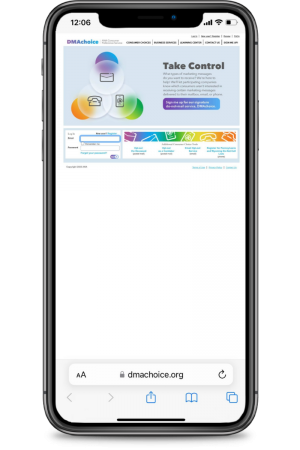
[Built for … Palm Pilot?]
Contrast this with the ANA’s shiny, mobile-responsive website used to showcase modern thought leadership to its Madison Avenue cohort. Given the lack of investment in keeping up with the times, it’s a fair question to ask whether DMAchoice is just an afterthought, or simply a token service intended to keep up the appearance of propriety.
Nevertheless, the site IS operational.
An industry that mails tens of billions of pieces a year maintains its consumer opt-out at the level of a fax line: technically operational, plainly unloved. That, more than any conspiracy, is what you are buying into.
¶The case for registering anyway
Now the other side, because it is real: DMAchoice does offer a unique value, where and when it works. It is a preemptive opt-out for a decent list of frequent national mailers.
One registration suppresses your address at roughly 1,100 large mailers at once, by our count of member companies published on its website. Hundreds of those companies have never mailed you, so there is nothing yet to opt out of; the registry gets ahead of the junk mail that has not arrived. Sender-by-sender opt-outs, ours included, are reactive by nature and cannot make that move.
The deceased ($6) and caretaker ($7) lists extend the same preemptive logic to the hardest mail there is, and those two lists even reach mailers monthly. Ten years of suppression is a fair trade, provided you carry the caveats above and expect a thinner mailbox rather than an empty one.
¶Self-regulation for junk mail - is it working?
Not to get all philosophical, but here’s a question:
Are billion-dollar industries – absent regulation – capable of self-regulating and safeguarding consumers?
Whether you’re an optimist or a pessimist here, it’s important you know the same associations of corporate advertisers that lobby for the $35.8 billion direct mail industry are its de facto policemen as well.
These associations include:
- The Data & Marketing Association (DMA), originally founded in 1917 as the Direct Mail Association (celebrating 110 years of junk mail!), and
- The slightly older Association of National Advertisers (ANA), founded in 1910.
In mid-2018, these two organizations merged into the “greater” ANA, which now requires each of its members to uphold an ethical code of marketing conduct.
The same preference service has sat through every name the industry gave itself. The Direct Mail Advertising Association opened the Mail Preference Service in 1971. It became the Direct Mail Marketing Association in 1973, the Direct Marketing Association in 1983, and the Data & Marketing Association in 2016. The ANA took the group in 2018. Direct mail, then direct marketing, then data and digital. The registry stayed. So did the catalogs.
Ethical platitudes aside, self-regulation has a plain appeal: a list your trade group runs beats a law you do not write. The largest mailers can claim they are acting responsibly, within a system that looks and smells the same as industry-run opt-out mechanism for prescreened credit offers, which is actually government mandated. Fifty-five years on, there is still no federal do-not-mail law.
¶DMAchoice vs PaperKarma
Side by side, the registry and the catch-all.
| **DMAchoice** | **PaperKarma** | |
|---|---|---|
| **Cost** | $8 one-time +$6 deceased, +$7 caretaker | $25/year ~$2/month |
| **Scope & coverage** | ~1,100 participating organizations | 100,000+ mailers across every stoppable category, DMA members and non-members alike |
| **How opt-outs move** | Batch suppression file; mailers scrub on their own schedules | Direct opt-out filed with each sender, most processed within 24 hours |
| **Duration** | 10 years | 5-10 years per mailer |
¶The right way to use it
Register with DMAchoice today, precisely because it is slow: the sooner your row exists in the file, the sooner the next scrub cycle picks it up. Add the deceased or caretaker list in the same sitting if either applies to your household.
Then work the junk mail the registry will never touch. The wider plan is in how to stop junk mail. Use PaperKarma to snap a pic of the mail that keeps arriving – we id the sender and file the opt-out directly, whether or not that sender ever heard of the ANA, with most requests processed within 24 hours.
The pairing beats either method alone. The registry preempts the big participants; the photo stops everyone else, including the mailer sitting in your mailbox right now.
“DMAchoice is a scam; I paid and the junk mail kept coming.”
No scam involved: the suppression file is real and the large participants run it. The mail that kept coming was from the majority of senders who never participate, from participants between scrub cycles, or from categories the program has never covered, like your own bank's marketing and "current resident" saturation mail. Any disappointment is scope and timing, sold vaguely.
¶Frequently asked questions
Is DMAchoice worth it?
Yes, as a first layer. One registration preemptively suppresses prospect mail from roughly 1,100 participating companies for 10 years, including national mailers that have never mailed you yet. Set expectations by the ceiling – those companies send a minority of the junk mail in a typical mailbox, and results arrive in batch cycles, not instantly.
Does DMAchoice work?
For the mail it covers, yes. The large participants do run the suppression file, and registered addresses see prospect mail from those companies fall off. The ANA’s claim of an 80% reduction applies only to “prospect promotional offers” from participants, a narrow category, so your total junk mail volume drops far less than that figure suggests.
Is DMAchoice a scam?
No. It is the real mail preference service operated by the ANA, the Federal Trade Commission (FTC) points consumers to it, and participating companies do suppress registered addresses. The recurring disappointment is scope and speed, not fraud – it reaches only participants, on their schedules, and nobody checks their homework.
How much does DMAchoice cost?
$8 online or $9 by mail for a 10-year registration. The separate Deceased Do Not Contact list is $6 and the Caretaker list is $7, both one-time. Older guides, including the FTC’s, quote lower figures; the registration page at dmachoice. org is the current source.
How often does DMAchoice send its suppression file to mailers?
The ANA does not publish a schedule for the main file; only its deceased and caretaker lists disclose monthly distribution. Mailers then scrub on their own calendars, and in our direct work with mailers, quarterly cycles are common. That is why an opt-out filed just after a mailer’s scrub can take two cycles, six months or so, to reach your mailbox.
Why am I still getting junk mail after registering with DMAchoice?
Three reasons, in order of likelihood – the sender does not participate (most senders do not), the sender participates but has not run a scrub cycle since you registered, or the mail is a kind DMAchoice never covers, like existing-customer marketing, political mail, and “current resident” saturation mail.
What are the DMAchoice deceased and caretaker lists?
Two separate registrations – the Deceased Do Not Contact list ($6, one-time) suppresses marketing mail addressed to someone who has died, and the Caretaker list ($7) does the same for a living person whose mail you manage. Unlike the main file, both are distributed to subscribing companies monthly, and both quote about three months to take effect.
What is the best alternative to DMAchoice?
There is no drop-in free replacement, because the gap is structural – most junk mail comes from senders that belong to no registry at all. OptOutPrescreen covers prescreened credit offers, Catalog Choice covers participating catalogs, and PaperKarma works sender by sender across 100,000+ mailers, which reaches everything DMAchoice suppresses plus everything it does not.
Sources
- DMAchoice registration page (USD 8 online / USD 9 mail, 10-year term)
- DMAchoice consumer FAQ (90-day guidance; complaint process; what it cannot stop)
- DMAchoice consumer choice tools (“about 80%” prospect-mail reduction claim)
- Anchor Computer – DMA Mail Preference suppression processing (“4 million+ consumers”)
- ANA Deceased Do Not Contact registration (USD 6; monthly distribution)
- ANA Do Not Contact for Caretakers registration (USD 7; monthly distribution)
- DMA “Commitment to Consumer Choice” member requirements (monthly suppression use; training video and test)
- ANA Center for Ethical Marketing (current self-regulation framing)
- ANA press release – acquisition of the Data & Marketing Association (May 2018)
- Chief Marketer – DMA timeline (Mail Preference Service, 1971)
- Post & Parcel – DMA unveils DMAChoice with per-brand opt-outs (January 2008)
- FTC – How To Stop Junk Mail
- Jonathan Kamens – “DMA’s Mail Preference Service” (2009 critique)
- Winterberry Group, Outlook for Advertising, Marketing and Data 2026: Continuous Evolution (January 2026)
- PaperKarma internal data and direct mailer relationships, 10M+ opt-out requests, 2011-2026.